I first sent out a query in 2018. I’d been writing for years, but I’d started to feel a sense of urgency—that it was time to actually get my work in front of people and find out if it was any good. My friends all thought it was good, but that is always a tenuous source of feedback. Would they really say they hated it, even if they did?
Many times it was suggested to me that I not bother with the query process. Self publishing kept getting easier, some people were even making money off it, so why rely on gatekeepers? I struggled at times to explain why I didn’t want to do that without denigrating that option.
When it came down to it, I didn’t want to self publish because I didn’t believe in my own work enough to throw it out in front of readers without someone with qualifications first telling me it was good enough. I felt like I was just going to embarrass myself publicizing work that wasn’t ready. And I also felt that even if I did so, even if it sold okay, I would still not know if my work was any good. I needed the affirmation of a professional to tell me I had Made It, that my work met the standard of publishing. That I wasn’t just an amateur throwing up garbage for my own ego, which a few people bought, got five pages into, and didn’t finish because it was trash. In my head, that seemed very likely.
Plus, I knew perfectly well that my friends and family would hear “I have a book deal” and be proud, whereas if they heard “I decided on my own authority to put a book on the internet,” they’d see it roughly the same as me starting a blog. It wouldn’t be an achievement, not unless I sold lots of copies, and the odds of that were pretty low.
And for a long time, I did get a lot of affirmation from the query process. I felt like a professional, even when I was gathering dozens of rejections. Because of course all the successful writers got rejections. And when I got praise from agents or requests for pages, I felt justified for the first time in thinking of myself as a real author. Here were these professionals who actually sold books saying things like, “I have no doubt this will find a home somewhere else,” “The writing is professional in quality but I don’t think I will be able to market the concept,” or “I loved x, y, and z about this book, unfortunately my list is extremely selective these days.” I was meeting that bar at least. I was proving that my work was good enough to consider, if not good enough to actually sign.
But the process kept getting more and more exhausting and discouraging. After the fiftieth agent tells you that your work is good enough but it’s just getting so much harder to sell science fiction these days, you start to wonder: is the traditional publishing process really about proving I’m good enough? What if I’m already good enough, just not marketable enough?
The fact is that the publishing industry has been consolidating massively in the past few decades. It is not actually possible for me to rack up the number of traditional press rejections that Ray Bradbury got because there aren’t that many traditional presses I could submit to anymore! And each imprint publishing science fiction is only doing a few a year at most. Each agent who represents science fiction is signing one or two science fiction books a year and focusing more of their efforts on a genre that actually makes money, like YA or romance. (Not that this means those genres will get you in either—because there are so very many people competing for those slots too.)
I wanted to be good enough, but the fact is it’s more like qualifying for the Olympics than getting hired for a job. You don’t just have to be good, you have to be better than everyone else, plus writing the very most popular and marketable thing (and you can’t know in advance what that is), plus lucky.
I eventually decided to start submitting to small presses. The traditional presses have consolidated so much they’re not even publishing very much of the stuff I like as a reader, so why would I expect them to have room for me as a writer? Why not focus my effort on the narrow slice of readers like myself, through a press that was marketing to them specifically?
And it worked! I got a small press deal. For a while I rode that high, bragging to family and friends and feeling gratified that for once, someone believed in my work enough to risk their own time and money on it.
It’s meant the world to me that it’s sold copies, that it got good reviews, that people were talking about it.
But within a couple months after its release, I felt burned out again. It took such a short time for the buzz around my book to die down. The only way to keep it going was to post about it constantly, which made social media feel like work and made me worry I was annoying everyone. I loved the book, I love it still, I’m excited for when the sequels come out, but I was just exhausted. I couldn’t work on polishing the other books in the trilogy. I started writing a new book but was exhausted by that too. I couldn’t push out of my mind the question of what I meant to do with it. Get back in the query trenches, again? Research small presses, again? Who was going to want this book? Should I change things I liked about the book to make it more marketable? Did I still want that brass ring of a traditional publishing deal?
I’ll be honest: I still do want it, on some level. The attention from people whose judgment I already trusted. Editors and authors I already admired saying, “I’m so thrilled to be working with—” “This book blew me out of the water—” “I know you’ll love this—” The big cover reveal, book signings, getting invited to speak at conferences. I like affirmation and attention and I’m not going to pretend I don’t.
But deep down, I know I’d still want more. I’ve seen trad published authors burn out hard when they realize, even when they’re snapped up by a big house, they’re still left promoting themselves and organizing their own signings because there’s so little marketing budget. Having sales flop; having release dates delayed; getting their royalties split into so many portions it’s years before they get it all. And then after all that, it’s not like you’re in. You still have to stress about selling the next book.
I was so burned out, there was only one thing I could possibly do:
Write massive quantities of fanfiction.
When I write fanfic, it’s like I work with a different part of my brain. My internal editor is turned off. I don’t outline. I don’t ask what’s marketable. I assume nobody’s gonna read it, so I’m just having fun. It’s about the writing for once, not about the success.
Sure enough, the words poured out of me like a firehose. I wrote over 200,000 words of fanfic in the second half of the year.
I was surprised to find people actually did read the stuff. Previously I haven’t gotten much attention, but this time I landed on a really big fandom and boy do those people read and comment effusively. So, despite not writing for affirmation, I got it by the bucketful. People who didn’t pay a cent for the thing but who wanted to tell me it had meant something to them.
I learned two things from this.
First, I’m an absolute attention addict. I don’t like people looking at my face or hearing my voice but I go absolutely feral over people liking something I wrote. I found myself checking my email every twenty minutes or so to see if new comments had come in. The intensity of my reaction showed me that maaaybe all of this drive I’ve had to get published is less Me Chasing My Dream and more that I’m addicted to attention and praise and nothing will ever be enough. That’s a thing I’m trying to work on now. Because what’s the point in lowering the pressure by writing fanfic if the next thing I know I’m bringing that exact same thirst for affirmation to fanfic and no longer writing for the story?
Second, though, I learned what it is I’m writing for anyway. It is not money. I’ve earned some money on my published book and it’s great, I certainly can use it. But no amount of money could equal having a fanfic author I admire pop onto my fic and say “wow this is so good, I’m reading your entire catalog now, don’t stop writing because you are giving me LIFE.” Nobody on goodreads says that. To say nothing of the fact that every single one of my fics, even the short ones, has more comments than my novel has reviews, by a lot.
So, basically, I’m writing to get read, to share my thoughts and feelings with others, and hopefully to be told it meant something to them. This isn’t a perfectly pure motive—I know perfectly well I’m starving for praise and that’s not more virtuous than being greedy for money—but at the same time, if I understand that’s what I want, I can stop striving for something other than that. And I can narrow down the kind of attention I want. Do I really want attention from magazine reviewers and people who vote on awards? Or is it more important to me to get attention from exactly the kind of readers who are looking for what I write? I don’t know the real names or even genders of the people who comment on my fanfic. They probably aren’t famous or tastemakers of any kind. They just genuinely love the topic. So I’m trying to focus on the readers themselves. Not the editors, not the reviewers, and not the majority of people in the world. Just the kind of people who read the kind of niche, character-driven, thoughtful sci-fi I like to write. It doesn’t really matter if there are only five of them, so long as they pick up what I’m putting down and it makes them feel something.
That raises the question of what to do next. I have four completed novels sitting on my hard drive that I don’t know what to do with. Two have been queried to death; two have been queried a little before I lost momentum and despaired because I wasn’t getting requests.
Each has something really important to me in it. Each has been read by a couple people who said it was good. But I feel like each of them has farther to go. I might be discouraged about the traditional publishing path and bruised from so many rejections, but I’m still not ready to give up on them.
I decided self publishing might just be the perfect path for them. What if they don’t go far? What if they each sell ten copies? I feel like I’ve grown enough as a writer that I can be okay with that now. That I understand that one reader who has read my book is one person who was listening to what I had to say. They’re not a number, still less a number of dollars. It still means my book is out there, that it has a chance of going further than my google storage.
So I’m starting with one, the most polished and also probably the least marketable in traditional publishing. It’s a deeply weird book with aliens that don’t think like us at all. At the same time, it’s full of heartfelt moments and occasional humor. It’s got some subtle themes that ended up in there, but deep down it’s about friendship, about sisterhood, about the tension between freedom and love.
Also it’s about lizard people. Because this is what my brain is like.
This is a book that a small slice of the population might absolutely love. Most people probably will find it too weird, but people who like weird have so far been effusive about it.
Anyway, I got a friend to make me a cover for a price that is incredibly cheap for the quality of her work, got my husband to do the layout for free, and got tons of developmental feedback from my number one critique partner. (I think she’s taking other customers now? Try emailing her at meganesantucci at gmail dot com for a quote. I have never had better feedback from anybody, when it comes to plot and character and pace and so on.) I lost my job in September, so I wasn’t in a position to lay a lot of money out, especially because it may or may not make me any money. At the same time, I had to put out a quality product, because my standards are high where books are concerned.
It will be coming out on February 6 from all the usual online stores. The ebook will be everywhere, while the paperback will only be available from Amazon (because otherwise it gets more complicated).
Here are the cover and the pitch!
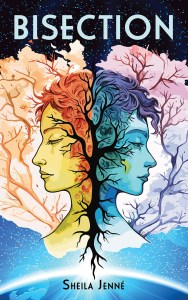
Tria and Resa have shared the same body since they were born. Like everyone on their home planet of Kinaru, their mind and body are divided down the middle: the logical right and the emotional left. Tria, the right, has a budding career as a biologist, while Resa dreams of more freedom than their home planet grants her.
When aliens land on Kinaru, Tria and Resa seize the opportunity to be the first of their people to travel to the stars. Karnath, the alien scientist assigned to study them, is convinced there is more to the Kinaru than meets the eye. But only days into the trip, crew members start turning up dead, and a mutiny redirects the ship toward a forbidden, war-torn planet—Earth.
To solve a conspiracy that threatens three planets, Tria must find out the truth of who her people really are, and Resa needs to finally tell Tria the dark secrets she’s been hiding all their lives.
Preorders are live from a number of outlets, and it will be out on February 6!
 Sheila Jenne, author