Star Trek is, as you probably know, one of my favorite fandoms of all time. Lately, Strange New Worlds has been giving me the vibe I remember from the Star Trek of my childhood: an expansive universe, episodic plotlines, and occasional hijinks. That’s why I like it much more than I liked Discovery, which tends to be darker.
However, last season had an episode that gave me pause, and I wrote an essay about it. Then I let it sit in drafts for almost a year. Oops.
Anyway, here is the essay, which I hope spurs some conversation. I feel like that episode flattens a complicated issue by making it purely a metaphor, when eugenics is a serious issue that has caused atrocities and still does, to some degree, today.
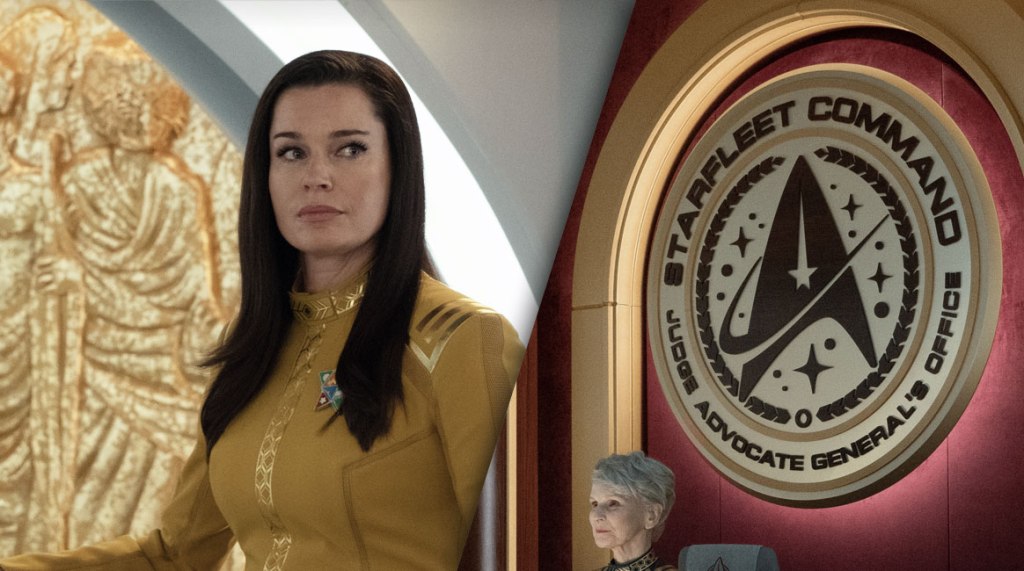
Eugenics Isn’t Just a Symbol for Bigotry
Like many viewers, I enjoyed the Star Trek: Strange New Worlds episode “Ad Astra Per Aspera.” While a courtroom episode can drag, my concern for Una kept me on the edge of my seat. I definitely agree that she is innocent—she did not choose to be genetically engineered, it was never done simply to earn her an advantage in Starfleet, and she should not have had to limit her own ambitions because of a law that doesn’t account for circumstances and punishes people who didn’t choose this for themselves.
Like in “Measure of a Man,” a science fictional concept ends up being a symbol for bigotry, and we are expected to stand up and cheer when a character we love wins her day in court—which I did. However, I found myself dismayed to find genetic engineering reduced to a symbol in this way, because it’s not as science fictional as the show seems to think.
Eugenics has a long history going back long before the Eugenics Wars the characters reference. It’s involved the non-consensual sterilization of marginalized people, including disabled individuals, and played a key role in the Holocaust. Just like the fictional Eugenics Wars, the Holocaust made the entire concept of eugenics deeply unpopular for generations.
But historical atrocities only provoke a visceral fear for so long. Eventually, people start to ask, “But couldn’t we do something similar, just in a way that isn’t horrifically bad?” Enter genetic engineering. If you could modify an existing genome, either at the embryo level or after the person is born, then you can hardly be said to be treating anybody as disposable, right?
Well, that’s the argument. And you can see the Strange New Worlds writers have swallowed it hook, line, and sinker. In the episode, the fear of genetic augmentation is just irrational, historical bias—the prosecution can’t think of any further arguments for it than this one.
In past Star Trek series, however, the point was given much more nuance. In Deep Space Nine, Bashir’s struggle to cope with his augmentation was a major plotline taking up multiple episodes. He was initially augmented to cure his intellectual disability, but the result was to make him far superior in both intellect and physical ability to the average human. The show asks us to consider whether it’s fair to the rest of Starfleet to be competing for promotions and honors against an artificially created superman.
We also see the risks involved when Bashir brings his augmented friends on board. Each of their augmentations went wrong in a different way, resulting in anything from impulsive behavior to complete catatonia. Was it right for Bashir’s parents to risk his health this way? If we allow augmented people into Starfleet, will it encourage parents to expose their children to such dangers, in the hopes of earning them a coveted spot on a starship?
In Enterprise, Dr. Phlox explains that his species uses genetic engineering and it isn’t a problem for them. The implication is that humanity wasn’t ready for the technology, because they used it for evil.
My question is this: have they learned yet? Are they ready?
The Federation is usually depicted as utopian. And yet there have been no small number of occasions when they’ve been tempted to treat people as things. We can consider the super-children created in “Unnatural Selection” without thought for their wellbeing. The Federation also tends to valorize talent and ability, to the point that Bashir’s parents couldn’t accept the possibility their child wouldn’t be as intelligent as his peers.
If you ask me, no society is ready to use genetic engineering until they have truly stopped treating some humans as more important or valuable than others. In Una and Bashir’s time, other officers envy them because they still haven’t moved away from the idea that your abilities define your value. They worry augments will out-achieve them, and it will be unfair.
In our time, despite our advances in cloning, prenatal screening, and CRISPR, I would argue we aren’t any more ready. Currently, prenatal testing has reduced the incidence of Downs syndrome by one third in the US and one half in Europe. This is not a cure—this is simply eliminating fetuses with the condition before they are born. Is this because, as a society, we all agree lives with Downs aren’t worth living? No—and yet it’s hard to resist cultural forces that tell us they’re worth just a little bit less. Parents can’t help but be aware the hard work of raising a disabled child will fall directly on their shoulders, with little support. They also know barriers will stand in their child’s way of living a full life after they reach adulthood.
The next frontier may be autism. Autistic self-advocates have been sounding the alarm on autism research for years now. The search for an autism gene could result in useful advances in autism screening and treatment. But critics are worried—quite reasonably—that it will only be used to select which fetuses to abort. When we decide that some genes aren’t worth passing on, we make a statement about the value of human life that, perhaps, we weren’t meaning to make. Our society does not believe that a happy, healthy person who can’t produce capitalistic value matters as much as someone who can.
I imagine a healthy society which has genuinely grown past eugenics would use genetic engineering to cure deadly or painful conditions which will actually cause suffering to the individuals who have them. Or, like the Illyrians, they might use it to adapt better to their environment. But they would not use these techniques just to get their children ahead in life, because there would be no “ahead in life.” Each individual would be genuinely valued for themselves, not for what they could produce or accomplish.
I would like to believe the Star Trek future is past today’s ableism. And yet, evidence from the show suggests not entirely. Not when Pike’s projected disability is depicted as equivalent to death. Not when Bashir’s parents were willing to risk seriously injuring their child rather than have him grow up less smart than his peers.
In the Next Generation episode “Masterpiece,” a character tells Geordi, “It was the wish of our founders that no one have to suffer a life with disabilities.” I leave you with his answer: “Who gave them the right to decide whether or not I should be here, whether or not I might have something to contribute?”
Genetic engineering isn’t banned in the Federation just because humans are bigoted and haven’t gotten over their historical trauma. It’s banned because nobody has the right to decide what forms of human diversity—what could be infinite diversity, in infinite combinations—are worth keeping. How to balance that crucial reality with the rights of individuals who have been augmented is an ongoing question that Star Trek should continue to grapple with.
 Sheila Jenne, author