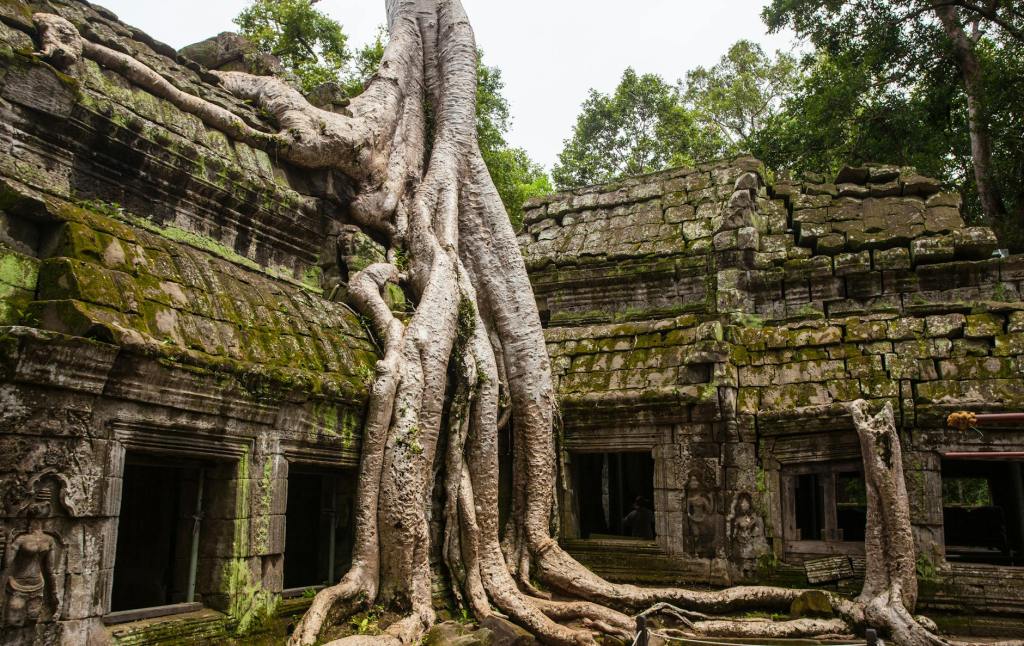
There’s a lot that goes into making a world feel real. Making a quick sketched-out backdrop is easy, but it feels a little like a cardboard screen dragged into place on stage. Readers won’t find it a vivid, fascinating place they’d like to go.
Settings that are a selling point of a whole book or series are more complicated than that. We have maps, supply chains, complicated political realities. One of the most important things to give a setting is history.
Tolkien is famous for this. About The Lord of the Rings, he said:
“Part of the attraction…is, I think, due to the glimpses of a large history in the background: an attraction like that of viewing far off an unvisited island, or seeing the towers of a distant city gleaming in a sunlit mist. To go there is to destroy the magic, unless new unattainable vistas are again revealed.”
He knows the trick of starting the story millennia into the lifetime of the world he created, so that there’s tons of history everywhere you turn. Nothing’s just a river, that river has a song attached to it, and everyone who knew the people involved has been dead for centuries. It’s a world with moss grown over the ruins already when you get there.
How different that is from the kind of prefab SFF setting where there is one king whose dynasty has lasted thousands of years, during which everyone has spoken the same language, had the same religion, and had access to the same books. I could hammer on pseudo-medieval worlds invented by people whose knowledge of the real Middle Ages comes exclusively from playing Dungeons & Dragons, but it’s just as bad when it’s “dystopia where the whole world operates by the same simple rules and no one has ever considered questioning it before” or “generic scum and villainy space cantina.”
These aren’t settings, they’re sets: a few background strokes to set up a story that is about something else. It’s fine if that’s the kind of story you’re writing. But as a worldbuilding junkie, I am always looking for more: a setting that could be a whole character in itself, a setting that drives endless plot. And to get that, you need to give your setting history.
History is big
The first thing I think it’s important to grasp is how large and crowded history is. You will never have ten thousand, or even five hundred, years pass with no major changes. The average empire lasts 250 years. Empires we think of as long change so substantially as they go that they’re hardly the same thing from beginning to end. The average dynasty within a kingdom is really only a few kings long.
The same is true of religions, which usually claim they don’t change and yet change dramatically over the years. The first pope was killed by the government. The middle popes crowned kings. And the current popes write ineffectual letters asking world leaders to please play nice. Politically, this isn’t the same reality.
Think of all the changes that have happened even in the last 100 years! In 1925, cars and telephones were new and exciting. There was no television or computers. It was illegal to be gay. Birth control was new and controversial. There weren’t many jobs a woman could have. There are only 24 governments in the world that have been the same since then.
You might argue that the past century is an exception and most aren’t that busy. That’s not wrong, but even centuries we think of as stable are in fact packed with events and changes. Let’s take AD 1000-1100. It’s full of stuff. The Catholic Church split in half, a schism which remains to this day. There were huge advances in medicine, math, astronomy, and various clockwork gadgets. The Normans invaded England. There were crusades. A map of 1000 and a map of 1100 are full of differences.
In the past thousand years, very little has stayed the same. Language has mutated, majority religions have changed, national borders have shifted and disappeared. Our version of English is only four hundred years old, and that’s if you consider Shakespeare and the King James Bible to be the same as what we speak today. Languages usually mutate even faster—the written word has fixed English in place as teachers train students to speak a standardized version and be capable of reading older texts.
So if you’re inventing a 100,000-year space empire with the same culture and language and dynasty throughout, you’d better have some way to explain that. Is the king a powerful robot, or is everybody immortal, or what?
Complicated pasts make complicated presents
All those years of history will leave their mark on your setting. Their government, for instance, very likely has holdovers from past systems of government. Maybe their dictator is called the Humble Servant, because they have democratic roots and always swore they’d never have a king. Or maybe they’re a democracy now but a lot of people have titles and heraldry.
Every place contains its own mix of ethnic groups. Maybe everyone says those groups don’t matter, but there’s bad blood from conflicts they’ve had in the past. How do they cope with that? Do they just not talk about it, or are there active efforts to overcome it?
If I were to write about the United States, creating it on the spot with no history, I’d probably say all the states are equal, that the nation is racially diverse and naturally we’re all fine with that, and our system of government is logical and easy to explain. In reality, there are tons of little details that reflect our history, explaining why are there bagels in New York and tacos in Texas. If we were writing the constitution today, I can’t imagine we’d even think of the Electoral College, but it made sense at the time.
And these things are going to come up, when you build a world as part of an active story. I used to live within walking distance of a major battlefield with cannons still sitting out. Roads had names like Stonewall, Lee, and Plantation. What does that say about the setting where I lived? What tensions are still lingering today over those historical events?
Books with great history
Fortunately, sci-fi is full of worldbuilding nerds like myself, so there are lots of great books with worlds grounded in history.
First on the list, of course, is the Vorkosigan Saga. (You knew I was going to say it!) Barrayar’s history is long and storied and comes up all the time. It was settled by humans from Earth, lost contact with Earth for centuries (the Time of Isolation), was invaded by Cetaganda and nuked, and then finally overthrew its invaders and began a transplanetary empire.
Parts of the planet are almost medieval, while the capital city is layered over with modernization and the wreckage of war. There’s a placard in the middle of a street showing where Ivan’s dad got murdered. It’s just that kind of place. And its government is incredibly byzantine, with a network of feudal lords who technically have to obey the Emperor and in practice often don’t. Every official act is draped with ridiculous pageantry that meant something at one time to somebody.
Next, the Imperial Radch deserves a mention. Not just because the main character is over a thousand years old, though that gives her the ability to tell us details everyone else has forgotten. But also because we are constantly running into colonization in progress: planets being taken over; planets that have been part of the empire for generations; planets that had competing political groups on them before they entered the empire and are still squabbling to this day. There are songs so old the whole language they are sung in has been forgotten. It’s one book where “a thousand years” really feels like a thousand years.
Lastly, I think it’s worth mentioning Some Desperate Glory. While the history in that book is not quite as long or complicated, thanks to being one book rather than a series, it’s vital to the story. A war only one generation ago left deep scars. But as you read on, you start to learn about other history than that, history that originally was overshadowed by the war they’re all obsessed with.
I find that long, real-feeling histories like that give a story depth and heft, make it feel like it’s taking place in a world like ours. What are some other books you’ve read that take place in a world with history?
 Sheila Jenne, author