At Trek Long Island this month, I had the wonderful opportunity to infodump to an audience about solar sailing for an hour. This is something I’ve always wanted; it’s an interest I’m obsessed with, know a lot about, and can rarely find anybody else to talk to about.
But a lot of people who weren’t there have expressed a desire to see the presentation, so I’m going to translate it to a written format so I can share all I know about it.
—
My interest in solar sailing began with a Deep Space Nine episode, “Explorers.” Sisko builds a solar sailing ship in an attempt to prove ancient Bajorans could have used one to sail to Cardassia centuries ago.
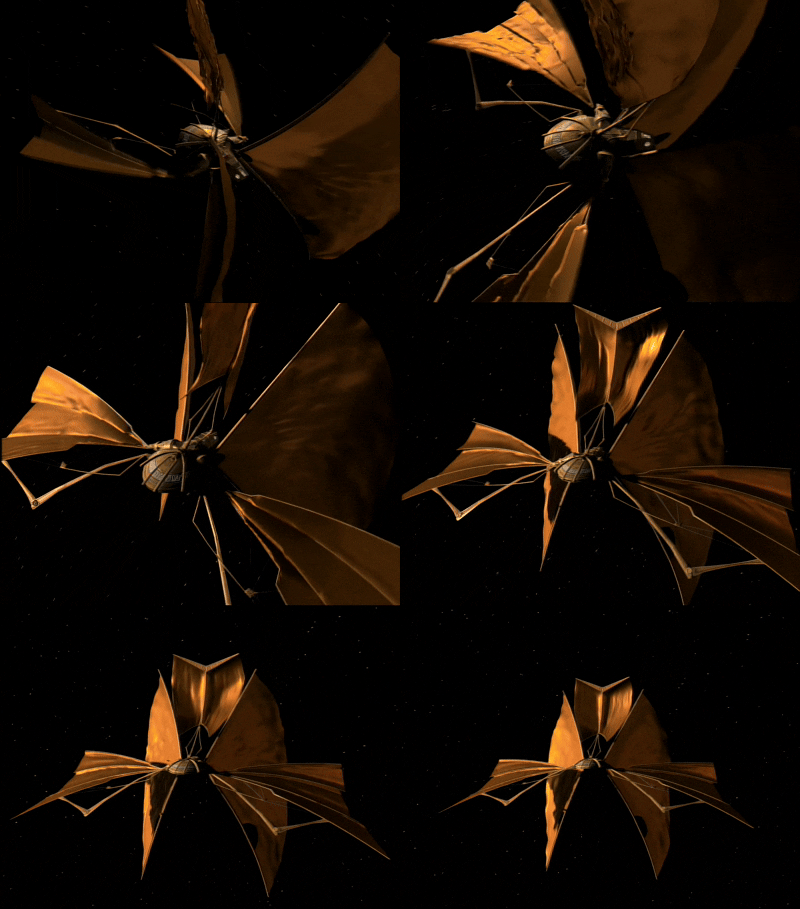
I think what appeals to me so much about the concept is how gentle it is. No fuel burning all over the place; this thing moves in harmony with nature. Ben and Jake adjust the sails by hand, with levers, just like you trim a sailboat.
Naturally when I started daydreaming about combining my love of sailing ships with science fiction, this was the concept I wanted to use. At first, I assumed it would be unrealistic. I know perfectly well most of the stuff you see on Star Trek isn’t real.
But as I learned more about the idea, I found out that not only could it work, it has. Solar sails are a tested and practical technology.
Does that mean everything we see in that DS9 episode is accurate? Well, no. I’ll explain what is and isn’t realistic about Sisko’s ship.
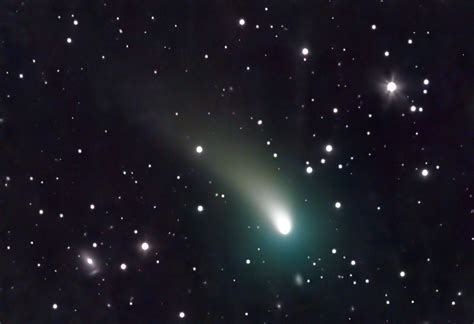
The concept of solar pressure was theorized centuries ago. Johannes Kepler first pointed out the way comet tails point away from the sun. A lot of people draw comets as if the tails are trailing behind the comets, but in fact they always point away from the sun, as if they were blown back by a strong wind. In 1864, it was proven that electromagnetic radiation itself exerts force.
A lot of people hear the term “solar sailing” and assume it is powered by the solar wind, which is a stream of particles heading away from the sun. In fact, the solar wind is a bit too unpredictable for sailing, and it exerts much less force. Instead, solar sailing is powered by light itself. Light exerts force on everything it shines on, and that force is predictable enough to be able to use it to get around.
How can light exert force to begin with?
It’s easy to see that if I threw a ping-pong ball at, say, a floating balloon, it would exert a force. When it hits the balloon, the ping-pong ball and the balloon both receive an equal and opposite force: the ball bounces off, while the balloon shifts sideways. We can say that the change in momentum of the ball is one force, and an equal and opposite force moves the balloon.
Light isn’t like a ping-pong ball; it has no mass. However, it does have momentum. So when a photon bounces off a reflective surface, it transfers momentum to that surface in just the same way.
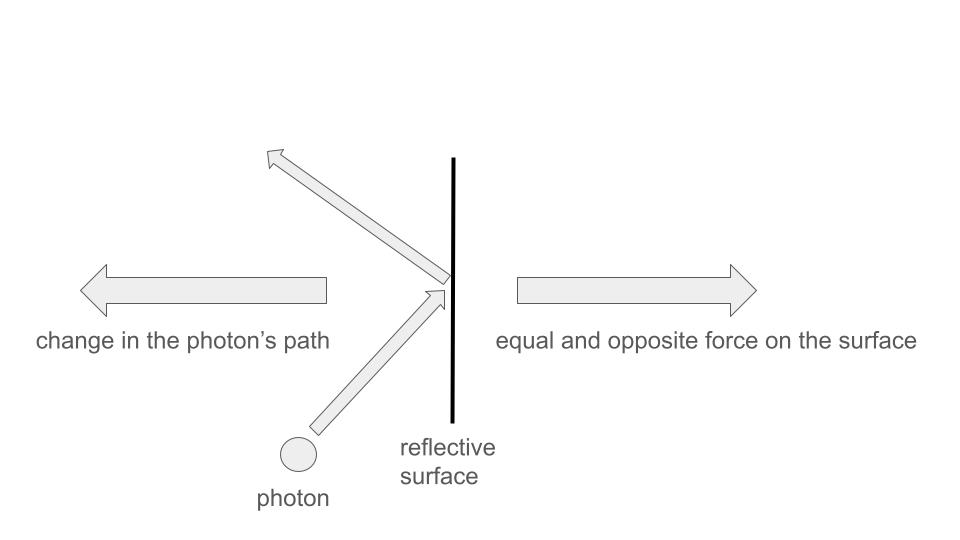
Even a non-reflective surface receives a force. When a surface reflects light, it’s actually receiving two forces: the force of being hit by the light, and the force of projecting it out again. So keep in mind that a black sail would receive force as well—just half as much.
Now some of you might be thinking, “But light doesn’t exert any pressure. I’ve never felt it.” Nobody on Earth ever has to account for the light moving things around.
The thing is that physics works very differently on Earth than it does in space. The same forces and laws are there, but there are so many different forces acting on any object on Earth that they tend to balance out. The Earth’s gravity, the Earth’s centrifugal force, the pressure of the atmosphere, friction, and so on, are always around. You barely notice them most of the time. But they are much bigger than tiny forces like solar pressure.
Because the force light exerts is minuscule. At the distance we are from the sun, a perfectly reflective surface would receive only 9 micronewtons of force for every square meter. A micronewton equals about the force gravity exerts on a grain of salt. If you put nine of them in your palm, you wouldn’t feel it.
But on Earth, there are forces to counteract the weight of those salt grains. The muscles of your hand, for instance. In space, an object has very few forces acting on it, such that even a tiny force like that can make a difference.
Time for another of Newton’s laws: force equals mass times acceleration. On Earth, you’re probably accustomed to having to exert constant force to keep things going, because of friction. For instance, if you’re pushing a shopping cart, you don’t just give it a good push and follow it to the end of the aisle. You’ve got to keep pushing or it stops.
But in space, a constant force means the object accelerates. So those tiny little salt-grain-sized forces add up over time. Imagine dropping nine more salt grains onto your hand every second. At some point, if they didn’t fall off, they’d get too heavy to hold up!
Ready for the solar sailing equation?
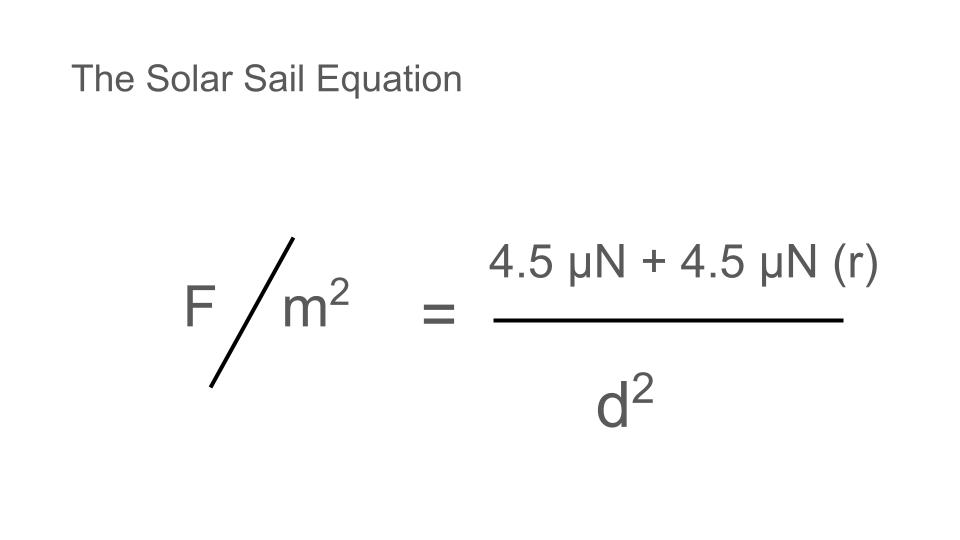
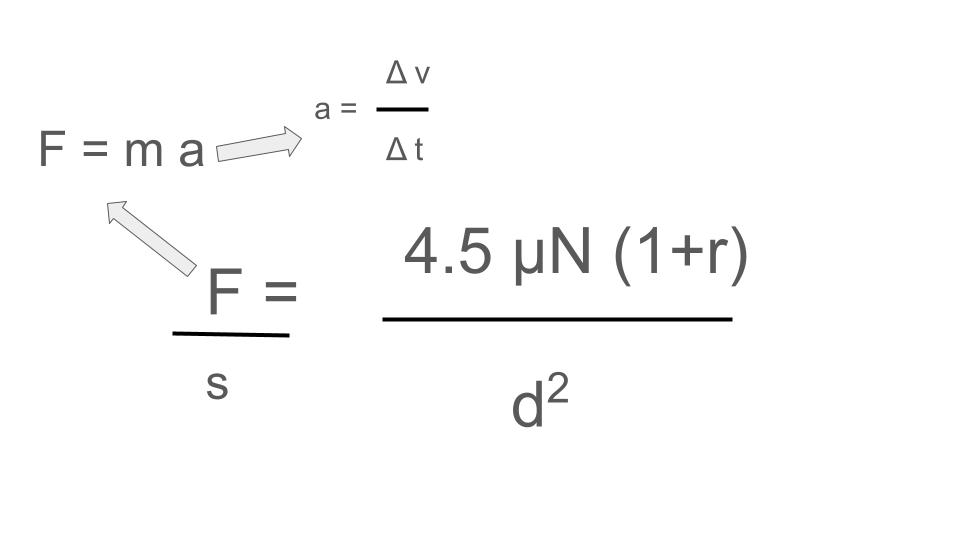
So: for every square meter of perfectly shiny sail, we have 4.5 micronewtons from the light hitting it, and 4.5 from the light bouncing off again. If we want to be precise, we can multiply that second 4.5 micronewtons by a variable called r, which stands for reflectivity coefficient—how shiny that sail is. Realistically we’ll never get 100% reflectivity, but we can get fairly close with the materials we have.
Now that number is based on Earth orbit, one AU from the sun. Solar radiation increases by the square of distance as you get closer to the sun, and decreases as you get farther away. So in this equation, we put the distance from the sun on the bottom in astronomical units, squared.
We can expand this equation out quite a lot, in order to see all the variables we really have in the picture.
We can expand force into mass times acceleration. And then we can expand acceleration into the change in velocity over the change in time. (I’ve changed the variable for the area of the sail to s, for the purpose of this equation.)
Now you can see all the things we can do to make our ship faster:
- make the sail as reflective as possible (r)
- start the journey closer to the sun (d)
- have a larger sail (s)
- have a smaller mass (m)
- accelerate for a longer time (t)
This last point is important, because solar sail voyages tend to take a long time. This is probably the most inaccurate part of the DS9 episode—the first day or so of the trip, they’d barely be moving. But after a few months, they’d be going at a really impressive pace. An increase in speed every second adds up!
Let’s try and compare solar sail performance with a conventional rocket. Those are the numbers to beat, since we already know we can get to Mars with a rocket.
We measure spaceship performance in change in velocity (delta-V), not speed. After all, the Earth itself is going very fast, and so is Mars. The problem is not speed, but changing orbit to reach another planet. A conventional rocket going to Mars takes about 259 days, and in that time it uses a delta-V of 3900 meters per second. Can a solar sail match that?
Well, let’s plug some numbers into our equation. Assume a 10 kilogram probe, with a sail of 200 square meters. In 259 days, it could achieve a delta-V of 4,064 meters per second!
Mind you, that’s some back-of-the-napkin math, assuming a lot of things and rounding others. Let’s look at a real solar sail.
The IKAROS probe, launched by Japan in 2010, was the first functioning solar sail, as well as still the most impressive. It weighed 310 kilograms, with a sail area of 196 square meters. It got all the way from Earth to Venus in six months!
That’s a more impressive performance than my back-of-the-napkin example, in part because it was traveling closer to the sun. The further in it went, the more solar radiation it encountered, so the faster it could go.
Wait a second….
You may be asking yourself, how can a solar sail go toward the sun? The sun’s light always pushes outward. This isn’t like a wind sail, where tacking back and forth can bring us toward the wind. There’s no opposite force to push us the other way. So how does that work?
Well, just as you are in balance at this moment—gravity, air pressure, your muscles, friction—all canceling each other out so that you can sit still, every object in the sun’s orbit is also in balance. The forward momentum of each object is counteracted by the sun’s gravity, producing a circular trajectory.
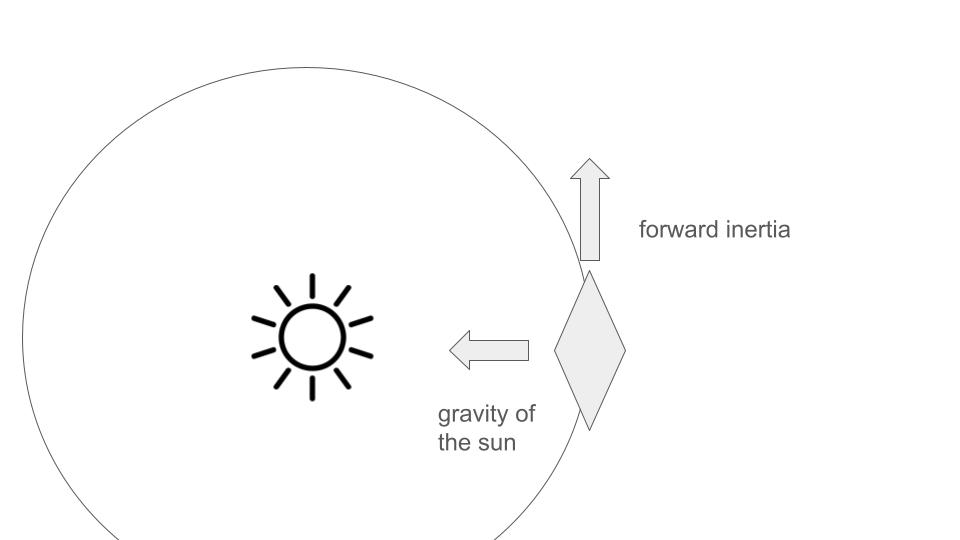
So a solar sail doesn’t have to produce a direct force in the direction you want it to go. All it has to do is disrupt its current orbit.
A solar sail is steered by putting it at angles to the sun. When light hits it at an angle, the force experienced by the sail results at the exact opposite angle.
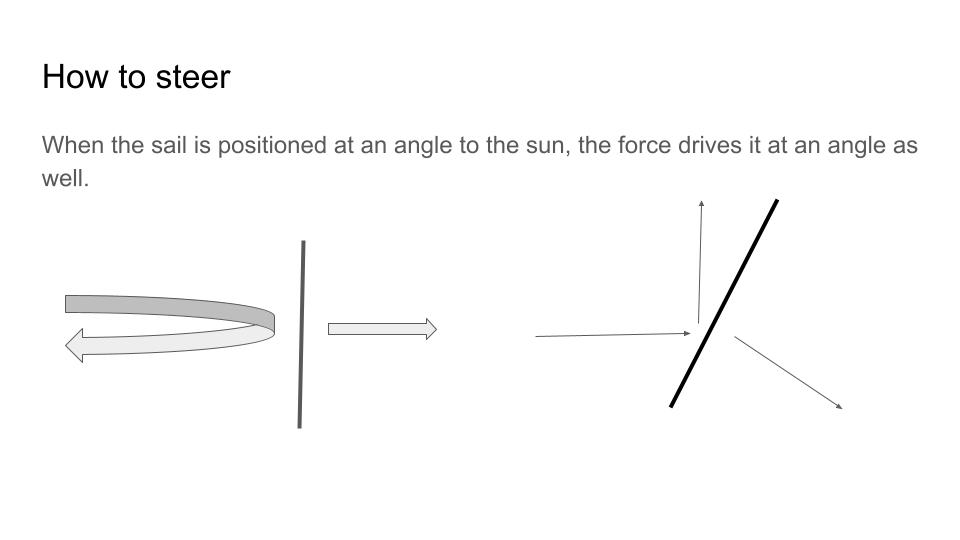
So while we can’t produce a force toward the sun, we can put the sail at an angle that will either speed up or slow down its orbit.
When an orbiting object speeds up, the it moves into a higher orbit. When it slows down, it moves into a lower one. That’s because the forward trajectory is no longer enough to balance the force of gravity the way it did before. Kind of like how, if you throw a ball hard, it goes a long way before falling to the ground, but if you throw it softly, it won’t go as far.
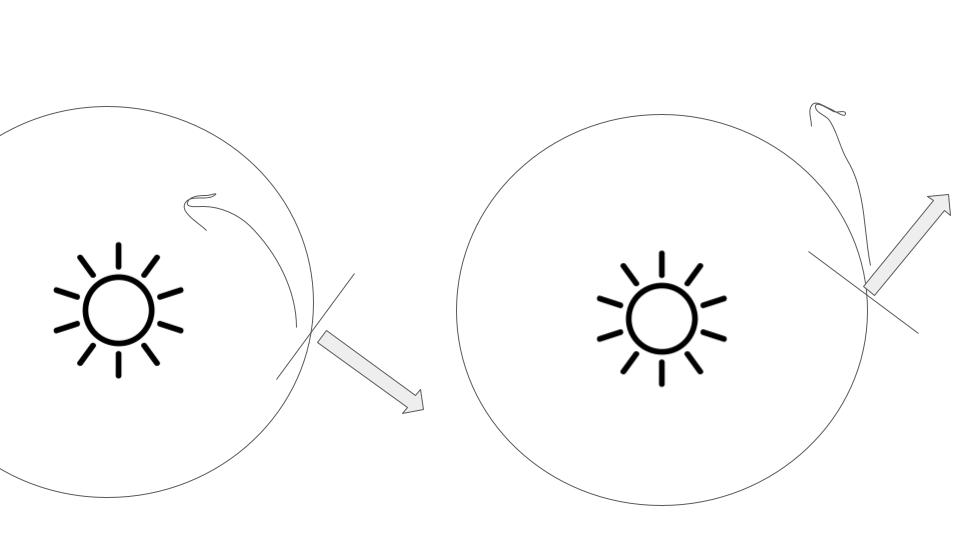
If you could slow down a probe enough that it was no longer orbiting at all…it would simply fall into the sun.
But are they practical?
It seems like there’s got to be a catch. If we’ve got this cool way of getting around in the solar system, and it can work as well as rockets, then why are we still using rockets for everything?
Well, just like objects in space, human affairs are governed by inertia. That’s the only way I can account for it. We do it with rockets because that’s how we always have.
Rockets have many disadvantages which we’ve learned to put up with. The biggest one is often called the tyranny of the rocketry equation: when you want to make a rocket faster, you have to include more fuel, but by adding more fuel, you make the ship heavier, which means it needs even more fuel. There comes a point at which you have to admit you’ve made the rocket go as fast as it’s going to, and it will have to coast the rest of the way.
The reason we’ve never gone to Alpha Centauri isn’t because of the speed-of-light barrier. You could go half the speed of light and still be there in a decade. But we simply don’t have any kind of rocket that could accelerate a payload to those kinds of speeds. There are no fuel stations along the way, so we’d simply have to reach the best speed we could and coast the rest of the way at much, much less than lightspeed.
And remember, every bit of fuel we’d need for this rocket has to be lifted out of the atmosphere. It costs thousands of dollars per kilogram to get anything out of Earth’s gravity well. A rocket mission has to be sent on a dedicated launch, costing hundreds of millions of dollars at least. Add one kilogram of mass to the ship, and you’ll have to add tens of kilograms of fuel, which could translate to hundreds of kilograms more fuel to launch the rocket out of the atmosphere. Of course all of this fuel has both an economic and an environmental cost.
Meanwhile solar sails are free of that problem altogether. Since they don’t use onboard fuel, they can accelerate indefinitely without increasing the cost of the mission. To increase their acceleration, we would have to increase the size of the sails, which do weigh something, so there is that consideration. But the materials used in solar sails are very light. So far we have made only small solar probes, but with the right materials we could probably go quite a bit bigger.
The solar sails deployed so far have been lifted to orbit in cubesats—little packages lifted to orbit in a rocket that was going up anyway. That is much, much cheaper for a smaller country or organization to take advantage of.
Are there any disadvantages to solar sails?
There are a few. First, they are not quite as precisely predictable as rockets, because the light of the sun does vary a tiny bit from moment to moment. Some steering may need to be necessary, and that’s difficult (though not impossible) to do with a remote probe.
They could not use the same kinds of trajectories that we use now for rockets. Interplanetary navigation currently relies on one big thrust to get the rocket going the right away, months of coasting, and then another thrust to slow down. Solar sails would have to navigate based on a constantly changing velocity, which is hard to calculate while also managing orbital mechanics. (I know. I’ve tried. I finally concluded I would need a lot more calculus than I have ever learned.)
At the sizes that have been actually tested, the weight of the sails and masts is fairly insignificant. But when we start thinking about extremely large sails, we have to question if a flimsy aluminum mast would be strong enough. And with the length of the mast, its mass would add up a bit. So scaling up might be more difficult than simply doing the same thing but bigger. That’s a problem we have to solve before we can dream of a manned solar sail mission—because humans are heavy, and our luggage is worse. (We really need to get better at recycling water, air, and even laundry before we can consider going as far as Mars, whatever kind of ship we use.)
Finally, there’s the question of space dust and debris. A few little holes in a sail aren’t going to destroy its overall efficiency, but over the course of a long mission, it might develop so many holes it can’t hold together anymore. I don’t know how much space dust is out there—what the ISS encounters isn’t typical, because we’ve littered all over low Earth orbit—but it’s something that would have to be considered for long missions.
Designing a solar ship
During Earth’s age of sail, sailing ships took on predictable shapes: a hull below with a deep keel, and big sails above. The more sails, the more speed the ship could make. Since wind doesn’t travel in a straight line, these sails overlapped, billowing into a cup shape to catch the wind.
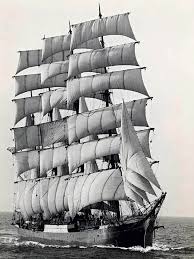
Solar sails follow the same rule of “the more sail surface area, the better.” But they don’t turn out looking like the ships in Treasure Planet, because sun and wind don’t work exactly the same way.
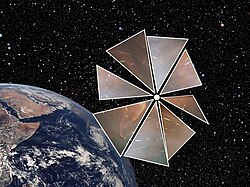
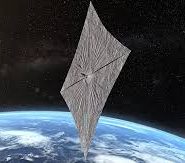
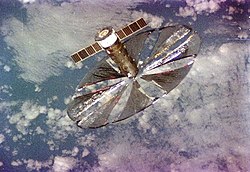
Light always travels in a straight line, which means sails that overlap are useless. Solar ships tend to be flat, filling in all the space possible with a circle or diamond shaped sail.
Sails must be as reflective as possible. They are usually pictured as silver or gold, but the most efficient sail would simply look bright—too bright to look at, when the sun was shining on it.
Wrinkles and billowing will reduce the efficiency, so the sails have to be pulled as smooth as possible. Some designs are slightly concave, which helps the sail stay aligned with the light. But that would also make it less steerable.
One crucial point in all existing solar sails is that they have to be collapsible to get to orbit in a tight package and unfold when they get there. That’s often the failure point: more than one experimental sail has gotten up to orbit and then failed to deploy.
Materials are as light as possible. One common sail material is just plain mylar. It’s thin, it’s cheap, it’s very reflective, and it weighs hardly anything. Masts can be any light metal. Since the forces involved are so small, they don’t have to be all that strong. Though as designs get bigger, you’d start to need stronger, lighter materials to hold all that sail without increasing the mass.
One thing that I don’t predict working is hybrid sail/rocket ships. Rocketry relies on lots of heavy fuel, while sails rely on cutting mass to a minimum. If you want to give a solar sailing ship a boost before opening the sails, you can, but you’d need to make the fuel tanks ejectable or they’d just weigh down the ship.
Real sails that have really flown!
Now I get to finally talk about IKAROS, which is an astoundingly impressive little spaceship. Normally, one makes advances in space one tiny test at a time. Certainly other groups trying to make sails have done so: first a model to test its deployment, then one that can raise and lower its orbit around Earth, and so on.
JAXA, Japan’s space administration, decided to go from zero to sixty. And they did it before anybody else had done it at all. They made this sail, sent it to orbit, deployed it, and sent it to Venus, all in one mission in 2010. That’s nine years before anybody else even got a functional sail at all.
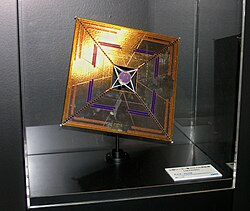
It was an incredibly neat gadget. 310 kilograms in mass, 196 square meters of sail. The sail had areas of photovoltaics, allowing it to charge its batteries at the same time. It also had areas that could be switched from reflective (creating the full amount of thrust) to absorbent (creating only half). And this allowed it to steer without having to actually move the sail at all: simply turning one half absorbent, and the other reflective, would naturally pivot the sail into the position desired.
It performed its flyby of Venus and continued functioning for another two years. After that, it started to lose attitude control, but it sent further telemetry until 2015. It’s still out there, though no longer responding.
The next successful solar sail was sent up by the Planetary Society in 2019. This was Lightsail 2, whose mission was simply to demonstrate the principle of solar sailing by raising and lowering its orbit around Earth. I think it’s neat that it was funded by a nonprofit instead of a government—demonstrating how solar sailing can be a much more accessible technology than rockets, because of the light launch weight. They were able to get it to orbit by renting space on somebody else’s launch vehicle.
In 2024, NASA launched the Advanced Composite Solar Sail System, designed to test lighter masts made of composite material rather than metal, as well as a new packing technique. Apparently you can spot it in orbit using NASA’s app!
Proposed ideas
We haven’t come close to exploring all the potential in this technology.
Solar sails do diminish in usefulness the farther they get from the sun. One solution to this could be lasers. By targeting a laser precisely on a sail, we could push it wherever we wanted—from a laser on Earth, on the Moon, or on a satellite. We could even make a relay of laser emitters leading out of the solar system.
One mission that’s been suggested is to create a swarm of tiny solar probes (for redundancy) and push them toward Alpha Centauri by laser. In that way, we could accelerate them far faster than a conventional rocket could go, getting them there in under 200 years.
Some have suggested that instead of making solar sails reflective, we could make them refractive. A translucent layer could bend light as desired for finer steering.
Magnetic sails would run on the Sun’s magnetic field instead of light. From what I can tell, they don’t have any real advantage over solar sails, but it would be interesting to see.
Fictional solar sails: let’s rank them!
For better or worse, you’ve now learned enough to know that most depictions of solar sailing in media aren’t accurate. I hope this doesn’t ruin anything for you. Personally, I enjoy watching imperfect things. The fact that I can nitpick them makes me feel smart, but it doesn’t spoil the fun.
Sisko’s solar ship
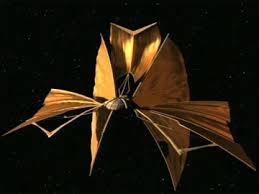
Now we can safely say that Sisko’s solar sail isn’t a great design. The sails overlap in places, shading each other—that would do no good at all. They also aren’t nearly big enough. The ratio required between the payload and the sails is huge; a real solar sailing vessel is bound to look like a teeny tiny little object in the middle of a vast array of sail. This doesn’t look good on screen, so you rarely see it that way.
The way the sail is used in the episode isn’t accurate either: they get up to speed in under a day and then tack back and forth, which would kill all their momentum to no purpose. They clearly drew more from water sailing than from physics. In their defense, the episode was made over a decade before any solar sail had been tested. And of course, the whole part where the ship goes to warp is just space magic.
That said, it doesn’t ruin the episode for me at all. The point still stands: it is sometimes possible to do amazing things with very old technology, because those things still work. This episode captivated my imagination the very first time I saw it, and I hope it does the same for others. Maybe people in a position to recommend more solar sailing missions!
Count Dooku’s ship
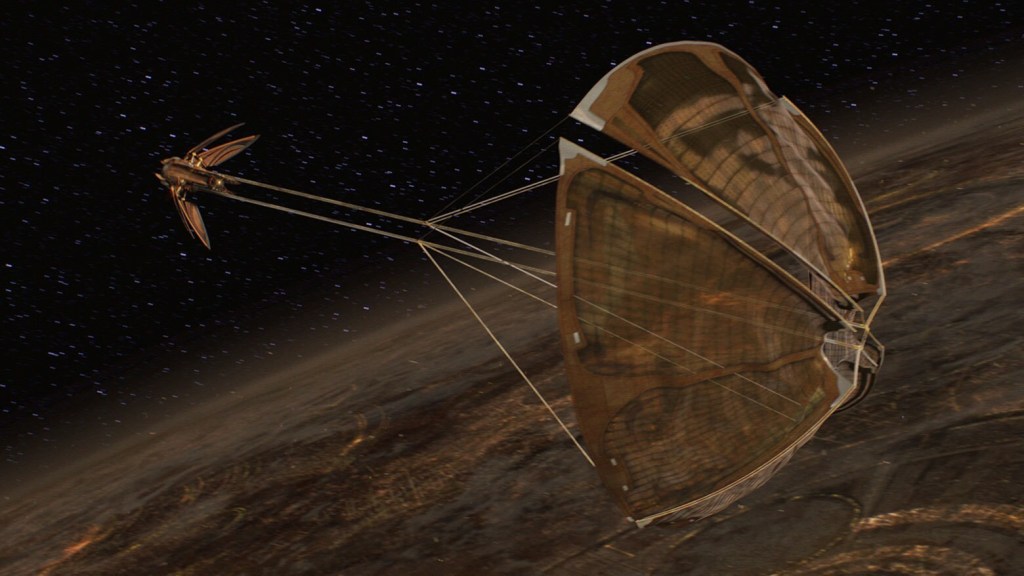
Star Wars has a solar sail which is…honestly I don’t even know what they think they are doing with this. You can’t capture light in a parachute like you can with wind. But I am assured that even in-universe this was just a stupid, flashy ship.
R’ongovian ship
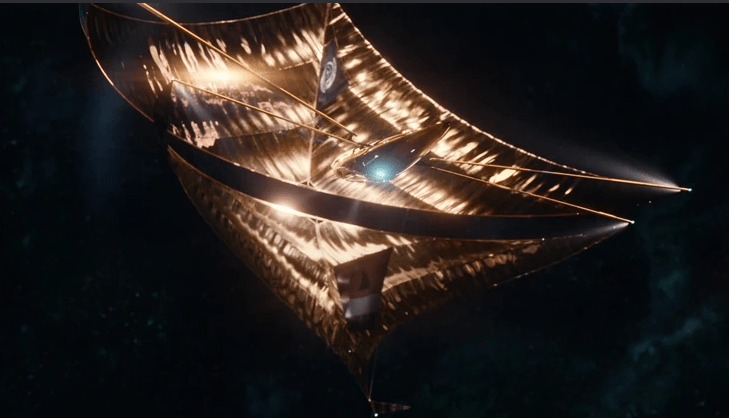
Strange New Worlds gave us a quick glimpse of an old R’ongovian ship. This is a lot more like it. The concave design would be good for staying steady on a straight course, and the larger size of the sails would get a decent amount of thrust.
Orion racing ship

Lower Decks featured a solar sailing race which I adored for its sailing-ship vibes and action. There’s…really nothing scientifically accurate about it at all, though. Solar sails do not produce that kind of acceleration or maneuverability.
But hey, it was very cool to watch!
Ship spotted in For All Mankind
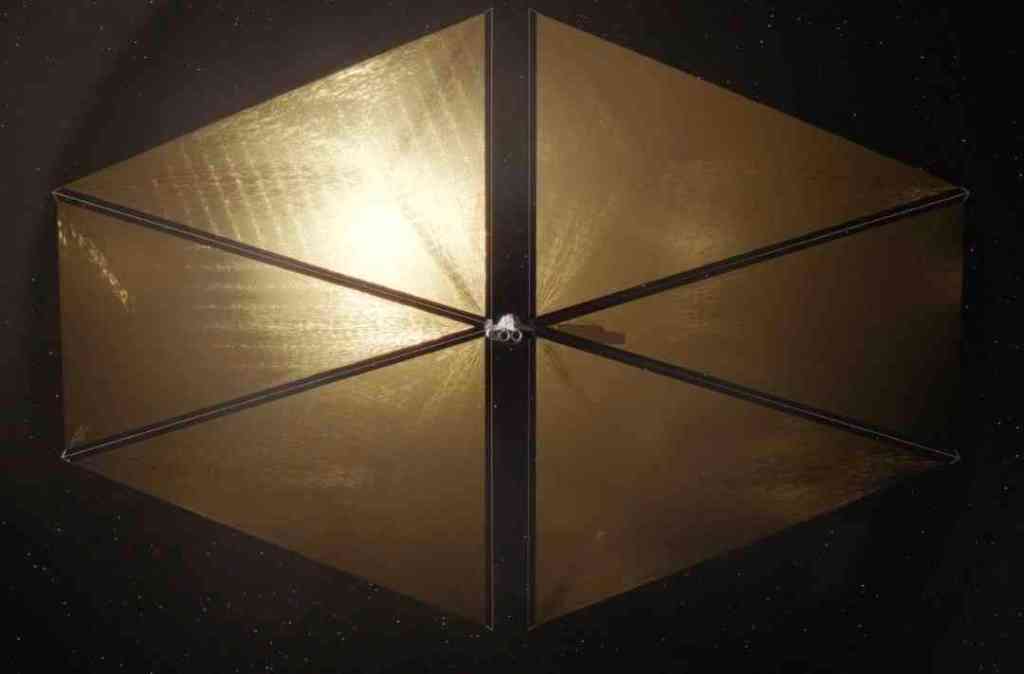
I haven’t seen For All Mankind, but just from the picture, I can see this sail would win. It’s huge, flat, and using all the available surface area to catch light.
Honorable mentions
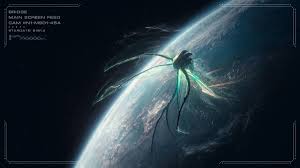
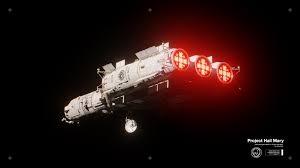
Two honorable mentions are the Jikaru, a living creature from Strange New Worlds, and the Hail Mary. Neither is strictly a solar sail, but the principles are similar. The Jikaru gets around by using the sun’s magnetic field, while the Hail Mary uses radiation pressure as generated by the astrophage. If you’ve seen the movie, you know the little critters “toot to scoot.” What do they toot? Light. Emitting light produces half as much force as reflecting it, but that’s still plenty, given the way they store the sun’s light to emit later.
To sum up
While Sisko’s ship isn’t entirely scientifically accurate, the principle is valid. It’s rare for the poetically appealing thing to also be practical at all. Yet here we are: there’s a proven technology, it’s cool as heck, and it may be the key to exploring outside our solar system.
I’d love to see more solar sailing missions take off in the coming years.
Learn more:
Project Solar Sail, a book with both fiction and nonfiction writings on solar sailing
The Planetary Society, a nonprofit you can join to fund space exploration

