Sometimes, whether by planning or just serendipity, you end up reading two very similar books at once. I was feeling very feminist so I dug out the paperback I bought ages ago of The Gate to Women’s Country by Sheri S. Tepper. And then I was blowing through that too fast, and was afraid to be left without a paperback to read at work (where I’m not allowed to be on my phone) so I decided to check out an ebook as well: The Female Man by Joanna Russ. All I knew about either was that they are both classic feminist science fiction novels, but they turned out more similar than I knew.
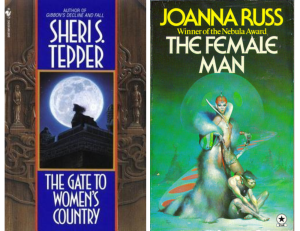
Both investigate the same basic premise: what if there was a world of all women? And, given this, what would the men be doing?
It’s a fascinating premise which any author is bound to explore very differently. The answer you come up with will show what you think gender is, to what degree it’s innate versus societally constructed. Would society fall apart if we didn’t have both men and women? Or would we actually be fine?
The Gate to Women’s Country
This book describes a post-apocalyptic, fairly low-tech world where both men and women still exist, but are strictly separated. Inside the city, and throughout the farmland outside, is Women’s Country: the place of hard work, learning, raising children, and really everything we think of as civilization. Men live in the garrison outside, and their only job is to be warriors.
We soon find out it’s a bit more complicated than that. Inside the city there are men, called “servitors,” who have chosen to return to Women’s Country after being raised from ages five to fifteen in the garrison. And outside the city is an encampment of women who have chosen to be prostitutes.
Twice a year, they have a carnival where boys can visit their mothers, and men and women can have sex. They also can communicate in the meantime over or through the city wall. So they really haven’t cured conflict and drama between men and women; a lot of the plot is about women getting manipulated by men, or trying to save the men they love by getting them to come back to Women’s Country.
This societal structure was invented to end the destructiveness of war. The calamities that destroyed society before, leaving fallout zones all over the place, were caused by men. Men’s aggressiveness, men’s competition, men’s antisocial behavior. Solution: men aren’t allowed any technology at all. They’re allowed to fight other men, but only with bronze weapons. They are not given any healthcare; if they are badly hurt on the battlefield, they simply die. That’s what they get for being warriors; it was their choice to live like that. Meanwhile the women get to be left out of warfare entirely, preserving civilization while men do their Man Stuff (murdering each other).
At this point, I started to get frustrated and a little baffled. This strikes me as a deeply cynical worldview. Really, men are just incapable of change? They have a choice but the vast majority choose to live like this? The fact of servitors struck me as a “not all men” copout, where sure, some men are lovely, but Male Nature as a whole is horrible. And I don’t really believe in gendered natures to begin with, so it lost me there.
But as I kept reading, I started to think, huh, no, actually I see it. Men aren’t evil, but their culture is deeply broken, and they propagate it because they get to raise all the boys from five to fifteen. You can watch it happen over the course of the book, as Chernon, a boy character, can see that his society is messed up, but feels pressured into going along with it. Boys are taught that returning to Women’s Country is shameful, whereas dying in battle is glorious.
I assumed that the women couldn’t help this situation. They did what they could, but the men like it this way and force them to put up with it because otherwise it would be worse. Women do all the work, give the men free clothes and food, and give away their male children (which absolutely devastates them), but this way at least they and their daughters are safe from male violence.
But a twist ending (which I don’t want to spoil) showed I was wrong about that. The conclusion the main characters come to is blatantly bioessentialist and eugenicist: men really are simply like that, and our only hope is that the violent ones all kill each other.
It’s difficult to say to what degree the author is actually espousing these views. That’s the problem of utopia and dystopia: just because the author creates a universe, doesn’t mean they actually want it to come to pass. For instance, it’s said that homosexuality has been “cured.” Is that problematic, in the sense that it makes the book anti-gay, or are we supposed to notice how messed up that is? Likewise, are we being told that eugenics is the cure to war, or are we meant to be horrified that they created this situation in which eugenics seems to be the cure to war? (I’m certainly horrified!)
I’m not sorry I read the book, because it was gorgeously written and had some heartwrenching reflections on life as a woman, surviving male violence, our love for our children, and so on. But it mostly made me want to write another book where they convince the men to let them raise their sons themselves, and within a couple generations they’ve raised kind boys who grow into kind men and end this whole violent nightmare.
The Female Man
It’s harder to explain the plot of this one, because it’s kind of surreal and not entirely self-consistent. Suffice it to say, there are a number of parallel realities, and some individual women cross over between them. We have our universe, represented by Joanna (who is, more or less, the author); a universe where WWII didn’t happen, represented by Jeannine; a universe where men have died out called Whileaway, represented by Janet; and a universe where men and women are at continual war, represented by Jael.
A lot of the book is about Janet navigating our universe and being shocked and repelled by sexism. Which is pretty satisfying to read about, because it’s the story of what a normal person who hadn’t been ground down by living under patriarchy would do. Janet punches men who grab her. She totally misses innuendoes. She introduces a new friend to lesbianism. I can’t help but love her.
Quite a bit, too, is rants by the author about being a woman under patriarchy. I ended up saving over a dozen quotations, because they are just so good.
“I love my body dearly and yet I would copulate with a rhinoceros if I could become not-a-woman. There is the vanity training, the obedience training, the self-effacement training, the deference training, the dependency training, the passivity training, the rivalry training, the stupidity training, the placation training. How am I to put this together with my human life, my intellectual life, my solitude, my transcendence, my brains, and my fearful, fearful ambition? I failed miserably and thought it was my own fault. You can’t unite woman and human any more than you can unite matter and anti-matter; they are designed to not to be stable together and they make just as big an explosion inside the head of the unfortunate girl who believes in both.”
Or this excellent bit:
“Of course you don’t want me to be stupid, bless you! you only want to make sure you’re intelligent. You don’t want me to commit suicide; you only want me to be gratefully aware of my dependency. You don’t want me to despise myself; you only want to ensure the flattering deference to you that you consider a spontaneous tribute to your natural qualities. You don’t want me to lose my soul; you only want what everybody wants, things to go your way; you want a devoted helpmeet, a self-sacrificing mother, a hot chick, a darling daughter, women to look at, women to laugh at, women to come to for comfort, women to wash your floors and buy your groceries and cook your food and keep your children out of your hair, to work when you need the money and stay home when you don’t, women to be enemies when you want a good fight, women who are sexy when you want a good lay, women who don’t complain, women who don’t nag or push, women who don’t hate you really, women who know their job, and above all—women who lose. On top of it all, you sincerely require me to be happy; you are naively puzzled that I should be so wretched and so full of venom in this the best of all possible worlds. Whatever can be the matter with me? But the mode is more than a little outworn.
As my mother once said: The boys throw stones at the frogs in jest.
But the frogs die in earnest.”
I could quote the whole thing, but you should really just read it yourselves. It’s a scream of rage against being shoved into a tiny little Woman Box. It was written in the seventies, and I do think things are better now. But not enough better, because it still feels all too relevant.
Toward the end we finally experience the world where men are at war with women, and this was particularly interesting to read parallel to A Gate to Women’s Country. As in that book, men don’t come off well at all. They’re cruel; they’re violent; they desperately need someone to oppress. In this case, they forcibly transition some of the weakest boys so they can have somebody to treat like chattel. (Some reviews say this part is transphobic. Honestly I’m not sure; I think it was mostly about how men require someone to oppress and will make one if necessary, not at all about actual trans issues. Certainly it is never implied that this practice is good. But that leaves open whether genuine trans ideas are good, given they never appear in the book.) Anyway: this book definitely comes down hard on the side of hating men. There are no good men in the book.
So we land on the dilemma of the book, which isn’t explicitly addressed, but I think we’re supposed to see it. Joanna (in the book, and possibly the real author as well) wants to be a man, wants to be acknowledged as a man, a female man. Meaning, I think, having the privilege of being a man in society while still being female-bodied. But also, all of the men in the book are horrible. So it makes one ask: why would you want to be a man when men are horrible? Is the only solution Whileaway, where you can have the privilege of being the Default Gender without actually being a man at all, because there are no men?
I’m not criticizing here. I think it’s a really valid question which feminists are always going to have to ask: what would it mean to be equal in a society where the dominant class is currently awful? Do we have to adopt awfulness to be treated the way they treat each other? Can one abandon the various toxicities of socially-constructed femininity (passivity, martyrdom, etc.) without taking up the toxicities of masculinity (aggression, selfishness, etc.)?
I think the answer may be “we can’t deconstruct femininity without also deconstructing masculinity; at the same time as we unlearn our subjection, they need to unlearn their domination.” But that’s a harder sell. Women want to cast off our patriarchal training because it harms us materially. Men are only harmed morally by theirs, which hurts them in the long run, but meanwhile they’re not very conscious of it. So they cling to it, either because they like it, or because they never really thought of it one way or another.
In the meantime, we can unlearn our own training as much as we want, but none of it seems to bring us any closer to equality. Sure, you can resist that vague social pressure that says girls aren’t good at math, and get a math degree. But then you’re stuck in a male-dominated career, where either you’re a feminine woman and get ignored, or you’re a masculine woman and get called a bitch, but neither one unlocks any privilege because they still know you’re a woman either way.
Anyway, the book doesn’t give a solution. We can choose not to get married, that’s a start. We can choose lesbianism. We can choose violence. All of these have their downsides. But in the end, we can’t go to Whileaway. The only universe we have to navigate is this one.
Similar books
These are far from the only two books out there with this essential premise. “The world of all men” and “the world of all women” are fun things to explore and reveal a whole lot about how people think about gender.
I Who Have Never Known Men: This was another recent read for me, but it didn’t say much about gender in general. It was just about a group of women who survive imprisonment and disaster—the absence of men is incidental. But it is relevant, I think, because if there had been men, there could have been children, and that would have changed everything. There’s a deep despair over everything in the book, and I think the lack of men is partly why.
Ethan of Athos: This one is a world of just men, and I enjoy it because it’s not about “what men are like.” The Athosians are just people who happen to be all one gender. (Most of them are gay; the rest are celibate.) They’ve solved reproduction by cloning ovaries and using gestation tanks, and they manage the things women used to do by actually paying people for them. It’s acknowledged that managing all the work that has to be done in society is really hard, and they have a complicated system for compensating people for caregiving work. They are shocked by the idea that on other planets they just make women do it all.
Ancillary Justice: This isn’t a world of all men or all women, but a world without gender altogether. Biological sex exists, but it’s not important and not signaled socially in any way. I do envy that world.
The Left Hand of Darkness: An absolute classic which everyone should read. There are no men or women on Gethen, everyone is sexless except a few days a month when they temporarily present as one or the other. As in Whileaway and Women’s Country, there is no such thing as war. It’s left as something of an open question whether you can have war without men. But they certainly do have violence.
Invasive: Okay, gonna cheat and bring in my book here. The Eosians don’t have two sexes, everyone can conceive and beget, so gender is unknown among them. I felt that, in the absence of sexual differentiation, people would find childbearing one of the most important things they ever did. If everybody’s doing it, you can hardly marginalize it.
My own thoughts on gender
I tend to favor the conclusion that the end of gender differentiation would be no big deal. A planet of all women wouldn’t be significantly different from a planet of all men. Without the opposite sex, people would simply have to step into new roles, and there would be no sensible reason to marginalize some of those roles. The erasure of either men or women would simply be an erasure of gender itself. Almost all of what we think of as masculinity or femininity would fade out, in the absence of anything to distinguish oneself from. There are some things that might hang on, because they’re driven by nature rather than nurture, but it’s pretty hard to say from here which things those would be.
This was definitely my feeling when I went to an all-girls boarding school. We weren’t particularly girly there. We were just people. All the jobs were done by all of us, and we weren’t competing for male attention because there were no men. (I hear all-boys schools aren’t nearly so utopian, though: make of that what you will.)
I fear saying this is going to be taken as me being against gender identity, but it’s not. Given that every human at birth is involuntarily shoved into one of two boxes, neither of which holds all of the things that are humanity’s birthright, naturally some of us are going to absolutely hate the box we’re shoved into, while others happen to fit into theirs better. Getting rid of the boxes altogether isn’t something we can do as individuals—gender is socially constructed. But you can (with great effort) switch boxes. Or you can simply vocalize your lack of consent for being shoved into either box—most people will still shove you into a box, but they can’t make you stay there.
If we lived in a world that didn’t involuntarily shove us into those boxes, how would we construct our identities? What divisions would we invent or discover? Would some people still love frilly dresses while other people felt wrong in frilly dresses? Would some people be attracted only to frilly-dress people and others not like them at all? It’s deeply impossible to say, coming as we do from a society that has its boxes so sharply defined and policed. It’s nice to think about, for sure. But whatever we came up with, I feel confident it wouldn’t be the patriarchy.
To sum up
Both of these books are pretty firmly man-hating, which is an attitude I feel ambivalent about. On the one hand, it’s absolutely natural to dislike people who oppress you. Men do behave badly sometimes! Every time we mention stuff like statistics around violence, or personal experience of abuse, women are accused of “man hating,” as if being angry at someone who treats you badly proves that you couldn’t possibly have been treated badly.
On the other hand, though, I think it’s vital to say firmly that it is not because of “male natures,” something essential to being a man that causes violence, oppression of women, and so on. If it were, it wouldn’t be their fault. But I feel pretty strongly that anyone capable of rational thought is capable of ethical behavior. We aren’t animals, directed only by instincts we inherit. We’re people and can make logical choices.
Bioessentialism is involved in racism and eugenics as well as in sexism and transphobia. It’s an ugly ideology with ugly results. If people can be born evil, then any bad treatment is justified—and any efforts to mend society won’t work. Much better to say that the bad things we associate with men are learned behaviors, socially constructed and hopefully socially deconstructible.
Both books are considered “second wave feminist,” and hence dated. But I don’t find either book irrelevant today. We haven’t overcome the struggles that inspired these books at all. However, I am glad we have brought more issues into the conversation, such as race, homosexuality, and trans identities. We should build on the work of second-wave feminists, not forget it.
A few more sci-fi authors who explored feminist issues:
- Margaret Atwood
- James Tiptree
- Octavia Butler
- Marge Piercy
- Nicola Griffith
- Charlotte Perkins Gilman
- Meg Elison
Who are your favorites? Which books have I missed?
 Sheila Jenne, author